![[personal profile]](https://www.dreamwidth.org/img/silk/identity/user.png) solarbird
solarbird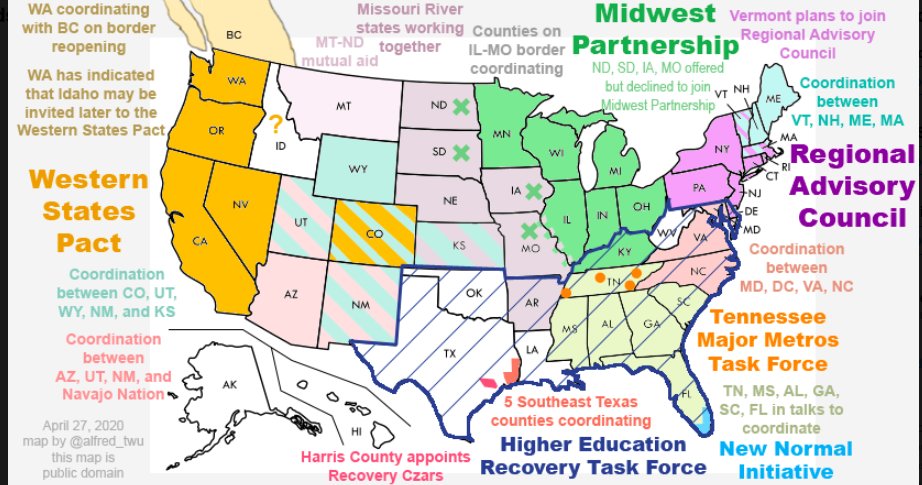
(simpler version, with more alliance names)
I think that says it all, really. But now, the headlines.
- Tennessee Restaurants Reopen As State Sees Biggest 1-Day Jump In COVID-19 Cases
- ACEP-AAEM Joint Statement on Physician Misinformation
- Colorado joins Western States Pact, pledging to follow science, not politics in fight against COVID-19
- Trump suggests U.S. shouldn’t bail out Democratic-run states
- Republicans Will Use the Coronavirus to Suppress the Vote
- Seattle’s Leaders Let Scientists Take the Lead. New York’s Did Not
- This Japanese Island Lifted Its Coronavirus Lockdown Too Soon and Became a Warning to the World
- Premier says timing on reopening the border with Washington state will largely be B.C.'s decision [EDITOR: And he's talking with Jay Inslee, not the US Federal government]
- We Still Don’t Know How the Coronavirus Is Killing Us
- Why did Maryland have to go to South Korea to get 500,000 tests?
----- 1 -----
Tennessee Restaurants Reopen As State Sees Biggest 1-Day Jump In COVID-19 Cases
April 27, 2020
Brakkton Booker
https://www.npr.org/sections/coronavirus-live-updates/2020/04/27/845682973/tennessee-restaurants-reopen-as-state-sees-biggest-one-day-jump-in-covid-19-case
Restaurants across Tennessee are able to welcome dine-in customers Monday for the first time in nearly a month as the state eases restrictions put in place to help stem the spread of the coronavirus.
The step toward some semblance of normalcy comes a day after the state reported its highest single-day jump in newly confirmed COVID-19 cases, 478, which officials say represents a 5.2% increase from the previous day.
The number of people confirmed to have the virus statewide as of Monday morning was just shy of 10,000 cases at 9,667, according to data compiled by the University of Tennessee, Knoxville.
----- 2 -----
ACEP-AAEM Joint Statement on Physician Misinformation
April 27, 2020
https://www.acep.org/corona/COVID-19/covid-19-articles/acep-aaem-joint-statement-on-physician-misinformation/
The American College of Emergency Physicians (ACEP) and the American Academy of Emergency Medicine (AAEM) jointly and emphatically condemn the recent opinions released by Dr. Daniel Erickson and Dr. Artin Messihi. These reckless and untested musings do not speak for medical societies and are inconsistent with current science and epidemiology regarding COVID-19. As owners of local urgent care clinics, it appears these two individuals are releasing biased, non-peer reviewed data to advance their personal financial interests without regard for the public’s health.
COVID-19 misinformation is widespread and dangerous. Members of ACEP and AAEM are first-hand witnesses to the human toll that COVID-19 is taking on our communities. ACEP and AAEM strongly advise against using any statements of Drs. Erickson and Messihi as a basis for policy and decision making.
----- 3 -----
Colorado joins Western States Pact, pledging to follow science, not politics in fight against COVID-19
Stephanie Butzer
Posted at 10:32 AM, Apr 27, 2020
https://www.thedenverchannel.com/news/coronavirus/colorado-joins-western-states-pact-pledging-to-follow-science-not-politics-in-fight-against-covid-19
Colorado, as well as Nevada, will join California, Oregon and Washington in the Western States Pact, according to a Monday morning announcement from the Office of the Governor.
Colorado Gov. Jared Polis and Nevada Gov. Steve Sisolak both made the announcement Monday morning.
The Western States Pact is a group of governors from the western states that have a shared vision for modifying the stay-at-home orders and continuing to fight the novel coronavirus. The governors have pledged that health outcomes and science, and not politics, will guide their decisions regarding COVID-19.
The governors of California, Oregon and Washington announced on April 13 that they would work together under this shared vision.
“Coloradans are working together to slow the spread of COVID-19 and have important information to share with and to gain from other states,” Polis said. “I’m thrilled Colorado is joining the Western States Pact. There’s no silver bullet that will solve this pandemic until there is a cure so we must have a multifaceted and bold approach in order to slow the spread of the virus, to keep our people safe and help our economy rebound.”
Polis said earlier this month he had been talking with the governors of Wyoming, Kansas, New Mexico and Utah about coordinating their plans together but that they had not formed an official alliance.
----- 4 -----
Trump suggests U.S. shouldn’t bail out Democratic-run states
Governors have asked for $500 billion as coronavirus strains economies
Published: April 27, 2020
By Robert Schroeder
https://www.marketwatch.com/story/trump-suggests-us-shouldnt-bail-out-democratic-run-states-2020-04-27
President Donald Trump suggested on Monday that federal money shouldn’t be used to aid states and cities run by Democrats, as he met with governors seeking billions of dollars in coronavirus assistance.
“Why should the people and taxpayers of America be bailing out poorly run states (like Illinois, as example) and cities, in all cases Democrat run and managed, when most of the other states are not looking for bailout help?” Trump tweeted. “I am open to discussing anything, but just asking?”
----- 5 -----
Republicans Will Use the Coronavirus to Suppress the Vote
The chaos party is planning for a chaos election.
By Francis Wilkinson
26 April 2020
https://www.bloomberg.com/opinion/articles/2020-04-26/coronavirus-helps-republican-vote-suppression-campaign
The April 7 election in Wisconsin was a moral, legal, administrative and public-health fiasco. It is also a model that Republicans intend to duplicate in November.
After Republican legislators and Republican judges forced Wisconsin to proceed with in-person voting over the objections of the Democratic governor, many voters had to choose between protecting their right to vote and protecting their health. Milwaukee, a city of almost 600,000, had just five in-person polling stations, causing long lines and lengthy waits. Some voters appear to have contracted the coronavirus.
Despite forcing voters to wade into a lethal virus, Republicans lost the marquee race for a Wisconsin state supreme court seat. Perhaps their vote suppression efforts were simply too obvious and egregious, inspiring some otherwise less-committed voters to run the corona gauntlet.
It’s impossible to know the net effect of this, or other, Republican vote suppression efforts. What’s clear is that Republicans in many states are committed to placing obstacles in the path of Democratic voters. Few Republicans appear to have qualms about this debasement of democracy; occasionally they celebrate it. The pandemic is a test of how far they will go.
----- 6 -----
Seattle’s Leaders Let Scientists Take the Lead. New York’s Did Not
The initial coronavirus outbreaks on the East and West Coasts emerged at roughly the same time. But the danger was communicated very differently.
By Charles Duhigg
April 26, 2020
https://www.newyorker.com/magazine/2020/05/04/seattles-leaders-let-scientists-take-the-lead-new-yorks-did-not
The first diagnosis of the coronavirus in the United States occurred in mid-January, in a Seattle suburb not far from the hospital where Dr. Francis Riedo, an infectious-disease specialist, works. When he heard the patient’s details—a thirty-five-year-old man had walked into an urgent-care clinic with a cough and a slight fever, and told doctors that he’d just returned from Wuhan, China—Riedo said to himself, “It’s begun.”
For more than a week, Riedo had been e-mailing with a group of colleagues who included Seattle’s top doctor for public health and Washington State’s senior health officer, as well as hundreds of epidemiologists from around the country; many of them, like Riedo, had trained at the Centers for Disease Control and Prevention, in Atlanta, in a program known as the Epidemic Intelligence Service. Alumni of the E.I.S. are considered America’s shock troops in combatting disease outbreaks. The program has more than three thousand graduates, and many now work in state and local governments across the country. “It’s kind of like a secret society, but for saving people,” Riedo told me. “If you have a question, or need to understand the local politics somewhere, or need a hand during an outbreak—if you reach out to the E.I.S. network, they’ll drop everything to help.”
Riedo is the medical director for infectious disease at EvergreenHealth, a hospital in Kirkland, just east of Seattle. Upon learning of the first domestic diagnosis, he told his staff—from emergency-room nurses to receptionists—that, from then on, everything they said was just as important as what they did. One of the E.I.S.’s core principles is that a pandemic is a communications emergency as much as a medical crisis. Members of the public entering the hospital, Riedo told his staff, must be asked if they had travelled out of the country; if someone had respiratory trouble, staff needed to collect as much information as possible about the patient’s recent interactions with other people, including where they had taken place. You never know, Riedo explained, which chance encounter will shape a catastrophe. There are so many terrifying possibilities in a pandemic; information brings relief.
A national shortage of diagnostic kits for the new coronavirus meant that only people who had recently visited China were eligible for testing. Even as EvergreenHealth’s beds began filling with cases of flulike symptoms—including a patient from Life Care, a nursing home two miles away—the hospital’s doctors were unable to test them for the new disease, because none of the sufferers had been to China or been in contact with anyone who had. For nearly a month, as the hospital’s patients complained of aches, fevers, and breathing problems—and exhibited symptoms associated with COVID-19, such as “glassy” patches in X-rays of their lungs—none of them were evaluated for the disease. Riedo wanted to start warning people that evidence of an outbreak was growing, but he had only suspicions, not facts.
----- 7 -----
This Japanese Island Lifted Its Coronavirus Lockdown Too Soon and Became a Warning to the World
By Abigail Leonard / Tokyo
April 24, 2020 6:27 AM EDT
https://time.com/5826918/hokkaido-coronavirus-lockdown/
Japan’s northern island of Hokkaido offers a grim lesson in the next phase of the battle against COVID-19. It acted quickly and contained an early outbreak of the coronavirus with a 3-week lockdown. But, when the governor lifted restrictions, a second wave of infections hit even harder. Twenty-six days later, the island was forced back into lockdown.
A doctor who helped coordinate the government response says he wishes they’d done things differently. “Now I regret it, we should not have lifted the first state of emergency,” Dr. Kiyoshi Nagase, chairman of the Hokkaido Medical Association, tells TIME.
Hokkaido’s story is a sobering reality check for leaders across the world as they consider easing coronavirus lockdowns: Experts say restrictions were lifted too quickly and too soon because of pressure from local businesses, coupled with a false sense of security in its declining infection rate.
“Hokkaido shows, for example, that what’s happening in the U.S. with individual governors opening up is very dangerous; of course you can’t close interstate traffic but you need to put controls in place,” says Kazuto Suzuki, Vice Dean of International Politics at Hokkaido University. “That’s what we now know: Even if you control the first wave, you can’t relax.”
----- 8 -----
Premier says timing on reopening the border with Washington state will largely be B.C.'s decision
Social Sharing
John Horgan says province following its own timeline about how and when to allow crossings
CBC News · Posted: Apr 17, 2020
https://www.cbc.ca/news/canada/british-columbia/premier-says-timing-on-reopening-the-border-with-washington-state-will-largely-be-b-c-s-decision-1.5536668
John Horgan hasn't said when the Canada-U.S. border will reopen between B.C. and Washington state, but regional planning around it is more important than a federal edict.
"We'll be making the best decisions in the interests of British Columbia, supported by the federal government," the premier told Matt Galloway, the host of CBC's The Current on Friday.
New modelling by health officials in B.C. shows that infections of coronavirus, which cause the respiratory illness COVID-19, have slowed to the point where it may be possible to lift some restrictions. That could mean the resumption of elective surgeries, economic activities and even possibly having students back at school.
...
Horgan commended the leaders on their co-operation over the pandemic despite regional differences and spoke to the CBC's Galloway about the strong relationship between B.C., Washington State, Oregon and California.
He said that Washington state Gov. Jay Inslee has been doing a "spectacular job" at managing the pandemic in his state and that the two are working together with other region leaders to devise a "seamless reintegration of activities" in the weeks to come, such as cross-border travel.
Horgan warned that it will not be all at once and not at the singular direction of Ottawa.
"It will not be ... the snapping of fingers and I think it will take guidance from Gov. Inslee rather than the federal government on these issues," he said.
----- 9 -----
We Still Don’t Know How the Coronavirus Is Killing Us
By David Wallace-Wells
26 April 2020
https://nymag.com/intelligencer/2020/04/we-still-dont-know-how-the-coronavirus-is-killing-us.html
Over the last few weeks, the country has managed to stabilize the spread of the coronavirus sufficiently enough to begin debating when and in what ways to “reopen,” and to normalize, against all moral logic, the horrifying and ongoing death toll — thousands of Americans dying each day, in multiples of 9/11 every week now with the virus seemingly “under control.” The death rate is no longer accelerating, but holding steady, which is apparently the point at which an onrushing terror can begin fading into background noise. Meanwhile, the disease itself appears to be shape-shifting before our eyes.
In an acute column published April 13, the New York Times’ Charlie Warzel listed 48 basic questions that remain unanswered about the coronavirus and what must be done to protect ourselves against it, from how deadly it is to how many people caught it and shrugged it off to how long immunity to the disease lasts after infection (if any time at all). “Despite the relentless, heroic work of doctors and scientists around the world,” he wrote, “there’s so much we don’t know.” The 48 questions he listed, he was careful to point out, did not represent a comprehensive list. And those are just the coronavirus’s “known unknowns.”
In the two weeks since, we’ve gotten some clarifying information on at least a handful of Warzel’s queries. In early trials, more patients taking the Trump-hyped hydroxychloroquine died than those who didn’t, and the FDA has now issued a statement warning coronavirus patients and their doctors from using the drug. The World Health Organization got so worried about the much-touted antiviral remdesivir, which received a jolt of publicity (and stock appreciation) a few weeks ago on rumors of positive results, the organization leaked an unpublished, preliminary survey showing no benefit to COVID-19 patients. Globally, studies have consistently found exposure levels to the virus in most populations in the low single digits — meaning dozens of times more people have gotten the coronavirus than have been diagnosed with it, though still just a tiny fraction of the number needed to achieve herd immunity. In particular hot spots, the exposure has been significantly more widespread — one survey in New York City found that 21 percent of residents may have COVID-19 antibodies already, making the city not just the deadliest community in the deadliest country in a world during the deadliest pandemic since AIDS, but also the most infected (and, by corollary, the farthest along to herd immunity). A study in Chelsea, Massachusetts, found an even higher and therefore more encouraging figure: 32 percent of those tested were found to have antibodies, which would mean, at least in that area, the disease was only a fraction as severe as it might’ve seemed at first glance, and that the community as a whole could be as much as halfway along to herd immunity. In most of the rest of the country, the picture of exposure we now have is much more dire, with much more infection almost inevitably to come.
But there is one big question that didn’t even make it onto Warzel’s list that has only gotten more mysterious in the weeks since: How is COVID-19 actually killing us?
----- 10 -----
Brian J. Karem
twitter.com/BrianKarem
27 April 2020
https://twitter.com/BrianKarem/status/1254914756512800771
My final question: If the testing is going so great why did Maryland have to go to South Korea to get 500,000 tests. twitter.com/realDonaldTrump walked off. No answer.


no subject
Date: 2020-04-28 10:50 pm (UTC)