Cascadia Uber Alles
Aug. 4th, 2005 11:52 am![[personal profile]](https://www.dreamwidth.org/img/silk/identity/user.png) solarbird
solarbirdI know, I know, I'm late with the politics post. Very late. It'll be up today, promise. But first!
As everybody probably knows, I'm working CascadiaCon, the Seattle NASFiC, or North American Interim Science Fiction Convention. I'm doing the at-convention newsletter.
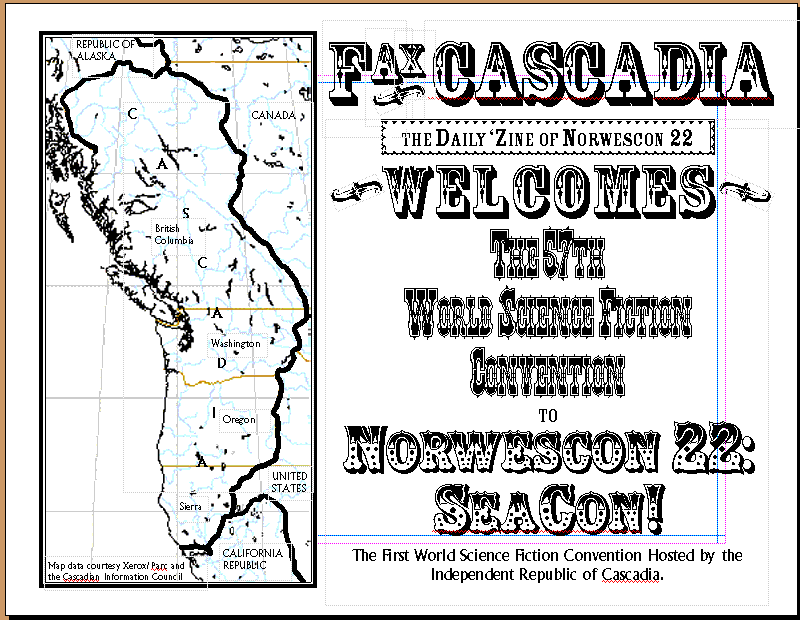
Since it works too well not to do it again, I'm reviving the old FaxCascadia shtick from Norwescon 22, and, along with it, the Independent Republic of Cascadia.
Over the last two days, I've written up 4300 words of backstory for the RoCas. Below the cut is the rough draft of the history. I've gotten a little feedback already; I'd like to get more, particularly things that might be funny.
So here it is. Lemmie know if you have things to suggest. I'm going to present it at the Saturday concom meeting, so that's kind of a deadline - not that we can't change things later, of course. Consistency goes out the window in the face of funny, if the funny's good enough. ^_^
The World Factbook
Cascadian Information Council
Republic of Cascadia
Introduction to Cascadia
Cascadia, a parliamentary republic located on the central and north-western coast of North America, gained its independence in 1973, following the temporary collapse of Federal authority in the United States of America. This chaotic period following the end of the Vietnamese-American War spawned revivals of regionalism across the North American continent, leading to the temporary or long-term independence of several states and provinces. At the 30 year point, several have emerged as viable economic and political entities looking in very different directions.
An Overview of the Historical Origins of Cascadia
The North American map has changed significantly since the end of World War II. At the time the Axis powers powers were defeated by a series of nuclear strikes starting with Dresden, Germany and ending with the Japanese colonial puppet government in Ulan Bator, Mongolia, there were six nations in North America: the United States, Canada, the Republic of Texas, the Mormon state of Deseret, Mexico, and the California Republic. All six were active in the war on the Allied side, with Canada entering as part of the greater British Commonwealth in 1939, the Republic of Texas entering in 1940 following Nazi attacks on its shipping, and the rest of the involved countries entering between 1940 and early 1942.
The 19th Century in North America
It is now an almost-forgotten note in history that at various points, three of these nations had attempted to merge with the United States at various points in their history; Texas's nearly-bankrupt national government entered annexation talks with the Americans in the 1840s, and, had it not been for the discovery of a process to take their large native supply of natural crude oil and turn it cheaply into a viable economic resource, it is likely that negotiation would have succeeded. However, the wealth brought to the state provided it a surprising lifeline, and support for annexation quickly fell. However, the relationship between the nations remained sentimental, thanks to American support for Texas independence from Mexico several years earlier - an important factor in Texas's then-surprising decision to remain neutral in the American civil war of 1861, and its decision shortly thereafter to phase out its local slavery system.
Deseret had similarly sent negotiators east in 1849, but religious conflicts and concerns over population density - or the lack thereof - prevented serious negotiations from taking place. A small number of border wars eventually ensued as American settlers moved westward, creating long-term suspicions between the two countries.
The California Republic, on the other hand, never sent negotiators east - instead, the Americans sent troops west as part of the Mexican-American war, expecting a quick capitulation after a brief occupation. The resulting popular uprising against Federal troops genuinely surprised the American government, which apparently really meant it when they expected large-scale popular support for annexation. After a brief and fairly embarrassing war, Californian independence was recognised by James Polk's government in 1848. It is generally believed that his rapidly declining health was a factor in his personal acquiescence; he died a mere two months after the peace treaty passed the Senate.
Each of these cases illuminate the apparent rule of independence in the 19th century: establish your country first, or, failing that, revolt against Mexico. All attempts to create countries from within English-speaking countries - the Quebec uprisings, the American War Between the States, the formation of the Second New England Confederation, the first War of the Redwoods in Sienna - failed, either through lack of sufficiently deep internal support (Quebec, SNEC) or through application of asymmetrical military power (CSA, Sierra).
The early 20th Century
The first half of the 20th century saw tremendous improvements in relationships between the various large-bordered and thinly-populated countries. A continental railroad network provided strong trade links between the newly-prosperous Republic of Texas and California Republic, with the industrial and agricultural powerhouse of the United States becoming deeply involved with both. Canada, too, shared in the growing North American prosperity, despite its closer ties with the British Empire. Canadian fears of American adventurism headed northwards never materialised, and through the booming 1920s, North America began to hold itself up as a model for peaceful inter-country cooperation on a continental level - a new chapter in the growing novel, "How not to act like those jerks in Europe."
The Great Depression of 1929 did little to change the spirit between the nations. With the North American countries having been largely exempted from the Smoot-Hartley tariff walls thanks to early efforts towards what would later become the North American Open Trade Area (NAOTA), Europe, again, set the bad example by spiraling downward towards war. With the advent of open hostilities, the stage was set for six long years of brutal war.
Post-war North America
The North American countries, having been almost entirely spared the devastation visited upon Europe, quickly entered into a period of economic prosperity. The North American Open Trade Area (NAOTA) was quickly formalised, and free-flowing Texas and American crude spawned a rush to newly-built tract housing. Californian troops returning from the Southern Occupied Zone in Japan seemed particularly enthusiastic about the prospect, as their nation fell particularly in love with the automobile and all the promises it brought of semi-rural life. Only Deseret and the Cascadian and New England areas of the United States seemed relatively uninterested; Deseret because of its religious aesthetic movement, New England because of its pre-existing population density, and Cascadia for reasons significantly related to geographic constraint. This was, perhaps, an early notice of that last region's divergence from the United States, culturally; indeed, its left-leaning politics earned then-Washington State the nickname of "America's Soviet Republic," and its largest city, Seattle, the appellation, "America's Canadian City." Clearly, the region was searching for its own identity, working to combine a large Asian population with its Scandinavian-American backbone, even before the crisis years of the Great Oil Bust.
The years of the Cold War, of course, require much greater discussion than can be afforded at this time. American and Texan forces more and more often found themselves fighting side by side in anti-Communist "police actions" and wars, starting with Korea in 1948. Deseret quickly became a country known for its anti-war stances, adopting a pacifist amendment to its constitution in 1953. California Republic military focus shifted primarily towards protecting shipping as diplomatic friction arose over the end of the occupation of Japan, particularly regarding certain elements of the new Japanese constitution; to this day, the areas of Japan formerly occupied by Californian troops are known for their relative nonconformity and economic diversity (see the "Japan's 'New Idea' Zone," previously published).
Meanwhile, in the United States and Canada, the continent's two largest countries, regionalisms again began making themselves known. British Columbians began to resent Ottawa's attempts to build a stronger central government to control the province's exploitation of its natural resources. French-speaking Quebec, with support from the post-war French government of Charles DeGaulle, began to assert itself over language and cultural issues. In the United States, both the Cascadian and New England regions spawned social movements against both segregation in the American south, and the fundamentalist movement in the American midwest. Economic strength and rising standards of living helped keep discussions civil - for a while.
The American-Vietnamese War
The fiasco of the American-Vietnamese War, however, began to break down the already-weak social bonds holding the American nation together. The Americans of the South and Midwest continued to be strong, even overwhelming supporters, while the New England and Cascadian regions were at least as stridently opposed. This, combined with a national civil rights struggle which would end segregation in the United States, further exacerbated regional tensions, with President Goldwater winning re-election in 1964 with the most geographically-divided electorate since the election of President Lincoln - and things did not get better. President Goldwater's desire to extend the war to China could not gain Congressional support, and attempts to negotiate a settlement between North and South Vietnam were simply unacceptable to their Texan allies, who demanded a march to Hanoi - something the American Congress was convinced with prompt a massive Chinese intervention.
Canadian-American, Deseret-American, and Californian-American relationships sank to new lows as all three countries accepted both American and Texan "draft dodgers" as political refugees. By 1967, inductee rates from the Pacific Northwest and New England regions had dropped nearly to zero, as state officials refused to apprehend or prosecute those young men unwilling to report when drafted.
The American Election of 1968.
In 1968, backlash against the civil rights movement in the south reached its zenith with the re-creation of the States Rights Party and its nominee, segregationist George C. Wallace. While Wallace had no chance of winning - support for segregation had already dropped precipitously, even in its strongholds - it, combined with the nomination of Cascadian National Party firebrand Dixie Lee Ray for president in three states, siphoned away enough votes from Democratic nominee Hubert Humphrey and the sardonic Republican Robert Dole to throw the race into the House of Representatives.
Stalemate in the House
As negotiations over a Presidential selection raged on in Washington, with anti-war Democrats refusing to accept the pro-war Hubert Humphrey or the conservative Robert Dole, Washington State and Oregon port officials began to refuse co-operation with Federal military officials over the war. With no clear successor to Barry Goldwater ready, Washington, DC did little to address the problem, forcing the American Army and Navy to rely on ships being sent through the Panama Canal from military bases along the Gulf Coast.
By the time Nelson Rockefeller emerged as a compromise President, the American government had been officially without a head of state for a month and a half, and Washington State and Oregon had been in noncompliance with Federal mandates for almost four months. American forces in Vietnam had continued to operate under the joint American-Texan Military Command, claiming significant success against Viet Cong forces in the aftermath of the Tet offensive. Upon taking office, Rockefeller immediately reiterated the necessity of a negotiated end to the war, and began a national tour to attempt to reunite the country, as well as extending several new diplomatic initiatives in an attempt to legitimise the Paris peace talks. Whether this effort would have been successful will be debated by historians for decades to come - early indications were promising - but his assassination in May of 1969 by a crazed gunman ended the effort.
In the Senate, the nomination and approval of Vice-President Edmund Muskie had proceeded apace, producing the first multiparty administration since the adoption of the 12th Amendment to the American Constitution in 1804, and he took the oath of office aboard Air Force Two within an hour of the death of President Rockefeller. His relative inexperience began to show immediately; his attempt to use troops to enforce Federal military mandates in Washington State and Oregon led directly to the beginnings of open rebellion in those states, and, on a barely more peaceful note, mass protests against the Federal government.
Cascadian National Party candidates swept both states' off-year elections in 1970, and CNP candidates, as promised, refused to recognise the authority of the Federal government, costing both states their representation in the Federal capital. The CNP, which by this time had spread to British Columbia, set up a government-in-exile in Victoria, as the provincial capital became the provisional capital. US-Canadian relations took an immediate nosedive, with President Muskie accusing the Canadian government - quite rightly - of allowing British Columbia to harbour anti-American revolutionaries.
The Election of 1972 and the Crash of 1973
President Muskie's attempts to continue President Rockefeller's policies led to a collapse of the American war effort in Vietnam by 1971; with American forces operating only by force on the then-American West Coast, and non-cooperation from California, frustration and exhaustion on the part of the Americans resulted in a near-complete withdrawal of forces by December. At that point, only Texan forces remained in Vietnam to continue the war effort.
The Texas military machine, meanwhile, drew massive amounts of the primary Texan natural resource - oil - and it was forced to divert more of these resources to the war effort it now undertook alone. When output began to drop in 1972 - due in part to overpumping, but mostly simply due to passing the point of peak production - the already-shaky American economy was forced to adjust to the prospect of massive oil imports at higher and higher prices.
As the American economy was already in recession, as is typical after armed conflicts, when the OPEC oil embargo hit, the United States was unable to continue enforcing its will upon regions that were not interested in going along. The states of Washington and Oregon declared formal independence on May 12th, 1973.
Transcontinental transportation largely collapsed. While the United States worked to keep its sole ally in the Middle East - democratic Israel - afloat, and keep the USSR at bay with its massive nuclear ICBM arsenal, it was in no position to take military action in its own back yard - and there was zero support for the nuclear option on the continent. Alaska, seeing that it could get away with it, quickly followed - while simultaneously declaring that United States military installations in the country could stay, free of charge. This strange arrangement, somewhere between devolution and full independence, became a model for the Third New England Confederation shortly thereafter. Nevada, always highly dependent upon cheap oil to keep its heavily-tourism-dominated economy running, saw a complete collapse of both Federal and State authority for a period of several years.
Canada found itself in a similar, though lesser, situation - there was never any threat of military action - with the secession of British Columbia and Quebec from Canada in August of 1973. Ironically, Quebec rejoined Canada as soon as they realised they did not have the money to complete their massive hydroelectric projects on their own - but did so in a much stronger political position, following the theme of Soverignty-Association, about which much has been written elsewhere. This strange parallel government system has survived until today.
1974: An Overview
The realignment of powers in North America was not yet over, however. Seeing the success of Quebec and Alaska, the Third New England Confederation negotiated a partial separation of powers from the Federal government, with unexpected support from conservatives in the southern states who saw the new policy as an opportunity to reassert the States Rights doctrine. Black separatists fought and won the establishment of a semi-automatous region in South Carolina.
The California Republic - which, like the United States and Texas, had supported Israel as the only democratic state in the Middle East - had also come under boycott by the OPEC nations, and had faced an economic crisis similar to that of the Americans. With even less natural oil resource than the USA, it found itself forced to negotiate a settlement when Sierra revolutionaries, sponsored in large part by expatriates to the north, declared the independence of several northern California counties in the brief but effective Second War of the Redwoods. Sierra negotiated first an alliance with Cascadia in 1975 when faced with a renewed threat from California armed forces, then full membership in the Republic of Cascadia almost immediately thereafter.
The Resource Wars of 1975
With the American government still in disarray and the California Republic legitimately facing armed banditry from Americans in Nevada, California seized several key water and resource sources along its eastern border, extending its boundaries further east by dozens of miles. Newly-independent Cascadia watched as unexpected support for the Cascadian cause erupted in northern Idaho, immediately accepting the northern counties of Idaho under Cascadian protection, and eventually, full integration into Washington (no longer "Washington State").
All this makes it sound much more clean than it was, and far more organised. In reality, the fog of war was never thicker in the modern era than in this period in the North American West. Paramilitaries operating with government license - modern-day privateers operating on land - often seized targets of use to one government or another. There are persistent theories that Nevada was allowed to lose territory to the Republic of California solely for the purpose of driving it, and other Mountain states, back to Washington, DC for protection - it is worthwhile to note the failure of Californian forces to take any of the most important uranium resources in that state. The full extent of Idaho cooperation with the northern county secession has never been understood, and probably never will be. This was truly a reappearance of the American frontier, albeit a brief one, and the exact history will likely never be known.
The Calming of 1980
Having missed one election, the American people were not ready to miss a second, and in 1980, elected Democrat Jimmy Carter to the White House. While President Carter's term was neither easy nor completely successful, his alternative-energy programme combined with as much support as the American government could muster for oil exploration in non-OPEC countries and the appointment of persons with aggressive approaches to inflation control eventually broke the back of the Arab oil cartel, and his calm approach to international affairs - and his extremely unpopular recognition of Cascadia, the adjusted California Republic borders, and the de facto soverignty-association relationship with the New England Confederation - helped, along with a good personal relationship with Cascadian president Dixie Lee Ray - to bring about a rapprochement between Americans and Cascadians. However, his failure to retake the Cascadian states prompted bitter retaliation from Southern voters, who rejected their native son, electing Republican George H. W. Bush, who moved from Connecticut to Oklahoma after the formation of the Third New England Confederation, to the presidency in 1984. President Bush's New England roots served him well, enabling him to lure the NEC further back into the general American governmental system, resulting in a general devolution of Federal power back to the states - a condition that left the NEC virtually identical to the rest of the country in fact, if not in name. His appointment of Alan Greenspan to succeed Paul Volkovich helped continue the recovery of the dollar and combat inflation, producing a sustained economic recovery throughout the 1980s and 1990s.
The current United States president is John McCain of Arizona; the vice-president is Nancy P. Hollister, of New York State.
---
The current California Republic president is Nancy Pelosi, of San Francisco, who replaced Larry Niven of Los Angeles. California has no vice-president; next in line of succession is the Speaker of the House of Representatives. (Richard Nixon served most of two terms in the 1970s, being impeached over charges of wiretapping in 1978.)
The current Premier of the New England Confederation, a regional subgovernment within the United States, is William Weld (Republican) of Massachusetts.
The current President of Deseret, who is by Constitutional mandate also President of the Mormon Church, continues to be Gordon B. Hinckley, after whom the Canadian band Barenaked Ladies reportedly named their first very silly album.
The current Prime Minister of Canada is Paul Martin (Liberal).
The current Premier of Free Carolina is John Roy Harper (United Citizens Party).
The current President of Texas is the extremely un-telegenic Karl Rove (Texan First Party) (Third term).
The current President of Alaska is Filthy Pierre (no relation) (Categorial Organisationalist Party). The Presidency being largely symbolic, the Prime Minister is Carlos Owens, whose Preparedness Party has introduced a crash programme to create insulated mecha for the Alaskan Self-Defence Forces. Cascadia and Japan are both contributing heavily to this three-way research group. Cascadia, Japan, and Alaska are all members of the North Pacific Defense Alliance (NPDA), pledged to come to each others' aid in the event of attack.
----- Notes about Cascadia Today:
Cascadia shows all the signs of young nationhood - including the inevitable insecurities and brashness. Cascadia has something to prove.
The Microsoft Corporation is a major economic player. So is Boeing. The chain of Barking Dog pubs has exported Cascadian microbrew across the world, just as the Starbucks coffee chain did before it. As a result, there is the beginning of a "Cascadia chic," an effort the Poodletarian National Party hopes to fuel and improve.
Cascadia, Japan, and Alaska are all members of the North Pacific Defence Alliance (NPDA), pledged to come to each others' aid in the event of attack. Cascadia and Japan are both contributing to a joint Mecha Development Project, for which Boeing hopes to be a primary contractor.
Today's Cascadia is a new member in NAOTA (North American Open Trading Area), but its strongest trading partner is Japan, followed by Canada. For inexplicable reasons*, the pronounced acronym makes Japanese negotiators giggle. (*It sounds like a cat sneezing.)
Major political parties in Cascadia are as follows:
Ruling Coalition:
1. Cascadian National Party (42% of seats)
- Gary Locke, current PM
2. Poodletarian National Party (10% of seats)
- Kelli Kirk, party leader, Minister of Swank. Other cabinet chairs
held include Minister of Funk and Minister of Suede.
Opposition Party:
3. Libertarian Party Cascadia (25% of seats)
- Calliandra Korra'ti, party leader, shadow PM
Other parties with MPs:
4. Survivalist (to the left of the Greens) (18%)
- Carole James, senior MP
(our timeline: head of the BC New Democratic Party)
5. Green Party Cascadia (4%)
- Sally Soriano, party leader, wanna-be shadow Minister of Education
(our timeline: highest elected Green in Washington State)
6. Monster Raving Looney CASCADIA (Two MPs, elected by accident)
- need a name
7. Reconstructionist USA (One MP, rural Oregon)
- Vance Day (our timeline: head of GOP Oregon)
Current government: CNP/Poodletarian coalition.
This is the first time the CNP has been forced into a coalition government.
Official opposition: Libertarian
Green and Survivalists likely to unite next election into one party, or at least an Survivalist/Green alliance. Their voting records are almost identical, tho' the Survivalists are simultaneously harder-line on some environmentalist issues and more libertarian in other areas. C.f. _Ecotopia_; the party is exactly the same as the one in the book, only smaller.
Reconstructionists (pro-reunification) similar in stature to British NP and about as successful, but not racist like BNP is. Social conservatives, nonetheless.
Nobody likes Prime Minister Locke, but nobody wants to vote for the Restructionists or the leftists either. Poodletarians are weak in Sierra and Oregon for some reason. Poodletarian endorsement has helped strongly in southern BC and western Washington.
Federal government is direct-election proportional using the Australian balloting system. (Vote for party and candidate in order preferences; winning candidate(s) within winning party take office; no primary or runoff.) Head of State is direct election, but largely ceremonial. Extensive Bill of Rights. Primary responsibility of Federal government is foreign affairs, education, and defence of individual rights.
I have a bunch of notes from last time to integrate into this, but they're mostly not history, but are current things. Like the Constitutionally-mandated subsidies for sex workers. ALL JOKES FROM LAST TIME STILL APPLY, so basically, it's a very weird country.
The CNP is the Defender of the Revolution, and despite this, is slowly falling out of power as they haven't really had any other positions. Washington's governor is Christine Gregiore, CNP, who lost a very cranky election against Green candidate Joe Szwaja and Libertarian Fritz Sands.
The Green centre of power is squarely in Seattle, with some inroads being made in Oregon. Poodletarians are strongest in Seattle and Vancouver. The Survivalists poll best through Oregon and Washington. Libertarians do best on the dry sides, have strong organisations throughout the southern three states, but are weakest in British Columbia. NDP support is spread evenly throughout the country. The Libertarians come closest to being a second national party.
City of Seattle government is partially Soviet, by which I mean the actual, original, Leninist Soviet system that got thrown out early. The City Council consists of three directly elected (city-wide) representatives, and one representative from the five District Councils - northeast, northwest, central, south, and west. Each District Council is made up of representatives from each recognised Citizen's Association within its geographical boundaries. Individuals may join any or no Citizen's Association. Neighrbourhood groups, for example, are a typical CA - the University Park Community Club is a CA, as is the Fremont Arts Council and the Ballard Chamber of Commerce. Citizens may be a member of more than one council, but may not represent more than one CA at their District Council. (Note: a version of this actually exists in our own timeline; I've served as a rep on the Northeast District Council. However, it doesn't send a Councilmember to the city, it mostly sends reports, and can send a representative without voting power.)
Any member of the City Council may introduce legislation. Legislation passes by majority vote, but at least one of the at-large members of the Council must vote for it.
The Mayor is directly-elected and exercises veto power. Council override requires at least a 2/3 majority, with the same caveat.
The national capital is Victoria. The British Columbia capital was, accordingly, moved back to New West, for reasons mostly having to do with Vancouver not having room and New Westminster having a building.
The national currency is the Kronar. Kronars are time-synchronised with the Japanese Yen, via Metric Time.
Top Reasons why Cascadia is the Party Capital of North America:
- We're Not Kansas
- Constitutionally-mandated subsidies for sex workers
- Hey, Baby, I got a Banana In My Pants
- National Anthem: "Yank my Doodle, It's a Dandy." (M. Noyes)
As everybody probably knows, I'm working CascadiaCon, the Seattle NASFiC, or North American Interim Science Fiction Convention. I'm doing the at-convention newsletter.
Since it works too well not to do it again, I'm reviving the old FaxCascadia shtick from Norwescon 22, and, along with it, the Independent Republic of Cascadia.
Over the last two days, I've written up 4300 words of backstory for the RoCas. Below the cut is the rough draft of the history. I've gotten a little feedback already; I'd like to get more, particularly things that might be funny.
So here it is. Lemmie know if you have things to suggest. I'm going to present it at the Saturday concom meeting, so that's kind of a deadline - not that we can't change things later, of course. Consistency goes out the window in the face of funny, if the funny's good enough. ^_^
The World Factbook
Cascadian Information Council
Republic of Cascadia
Introduction to Cascadia
Cascadia, a parliamentary republic located on the central and north-western coast of North America, gained its independence in 1973, following the temporary collapse of Federal authority in the United States of America. This chaotic period following the end of the Vietnamese-American War spawned revivals of regionalism across the North American continent, leading to the temporary or long-term independence of several states and provinces. At the 30 year point, several have emerged as viable economic and political entities looking in very different directions.
An Overview of the Historical Origins of Cascadia
The North American map has changed significantly since the end of World War II. At the time the Axis powers powers were defeated by a series of nuclear strikes starting with Dresden, Germany and ending with the Japanese colonial puppet government in Ulan Bator, Mongolia, there were six nations in North America: the United States, Canada, the Republic of Texas, the Mormon state of Deseret, Mexico, and the California Republic. All six were active in the war on the Allied side, with Canada entering as part of the greater British Commonwealth in 1939, the Republic of Texas entering in 1940 following Nazi attacks on its shipping, and the rest of the involved countries entering between 1940 and early 1942.
The 19th Century in North America
It is now an almost-forgotten note in history that at various points, three of these nations had attempted to merge with the United States at various points in their history; Texas's nearly-bankrupt national government entered annexation talks with the Americans in the 1840s, and, had it not been for the discovery of a process to take their large native supply of natural crude oil and turn it cheaply into a viable economic resource, it is likely that negotiation would have succeeded. However, the wealth brought to the state provided it a surprising lifeline, and support for annexation quickly fell. However, the relationship between the nations remained sentimental, thanks to American support for Texas independence from Mexico several years earlier - an important factor in Texas's then-surprising decision to remain neutral in the American civil war of 1861, and its decision shortly thereafter to phase out its local slavery system.
Deseret had similarly sent negotiators east in 1849, but religious conflicts and concerns over population density - or the lack thereof - prevented serious negotiations from taking place. A small number of border wars eventually ensued as American settlers moved westward, creating long-term suspicions between the two countries.
The California Republic, on the other hand, never sent negotiators east - instead, the Americans sent troops west as part of the Mexican-American war, expecting a quick capitulation after a brief occupation. The resulting popular uprising against Federal troops genuinely surprised the American government, which apparently really meant it when they expected large-scale popular support for annexation. After a brief and fairly embarrassing war, Californian independence was recognised by James Polk's government in 1848. It is generally believed that his rapidly declining health was a factor in his personal acquiescence; he died a mere two months after the peace treaty passed the Senate.
Each of these cases illuminate the apparent rule of independence in the 19th century: establish your country first, or, failing that, revolt against Mexico. All attempts to create countries from within English-speaking countries - the Quebec uprisings, the American War Between the States, the formation of the Second New England Confederation, the first War of the Redwoods in Sienna - failed, either through lack of sufficiently deep internal support (Quebec, SNEC) or through application of asymmetrical military power (CSA, Sierra).
The early 20th Century
The first half of the 20th century saw tremendous improvements in relationships between the various large-bordered and thinly-populated countries. A continental railroad network provided strong trade links between the newly-prosperous Republic of Texas and California Republic, with the industrial and agricultural powerhouse of the United States becoming deeply involved with both. Canada, too, shared in the growing North American prosperity, despite its closer ties with the British Empire. Canadian fears of American adventurism headed northwards never materialised, and through the booming 1920s, North America began to hold itself up as a model for peaceful inter-country cooperation on a continental level - a new chapter in the growing novel, "How not to act like those jerks in Europe."
The Great Depression of 1929 did little to change the spirit between the nations. With the North American countries having been largely exempted from the Smoot-Hartley tariff walls thanks to early efforts towards what would later become the North American Open Trade Area (NAOTA), Europe, again, set the bad example by spiraling downward towards war. With the advent of open hostilities, the stage was set for six long years of brutal war.
Post-war North America
The North American countries, having been almost entirely spared the devastation visited upon Europe, quickly entered into a period of economic prosperity. The North American Open Trade Area (NAOTA) was quickly formalised, and free-flowing Texas and American crude spawned a rush to newly-built tract housing. Californian troops returning from the Southern Occupied Zone in Japan seemed particularly enthusiastic about the prospect, as their nation fell particularly in love with the automobile and all the promises it brought of semi-rural life. Only Deseret and the Cascadian and New England areas of the United States seemed relatively uninterested; Deseret because of its religious aesthetic movement, New England because of its pre-existing population density, and Cascadia for reasons significantly related to geographic constraint. This was, perhaps, an early notice of that last region's divergence from the United States, culturally; indeed, its left-leaning politics earned then-Washington State the nickname of "America's Soviet Republic," and its largest city, Seattle, the appellation, "America's Canadian City." Clearly, the region was searching for its own identity, working to combine a large Asian population with its Scandinavian-American backbone, even before the crisis years of the Great Oil Bust.
The years of the Cold War, of course, require much greater discussion than can be afforded at this time. American and Texan forces more and more often found themselves fighting side by side in anti-Communist "police actions" and wars, starting with Korea in 1948. Deseret quickly became a country known for its anti-war stances, adopting a pacifist amendment to its constitution in 1953. California Republic military focus shifted primarily towards protecting shipping as diplomatic friction arose over the end of the occupation of Japan, particularly regarding certain elements of the new Japanese constitution; to this day, the areas of Japan formerly occupied by Californian troops are known for their relative nonconformity and economic diversity (see the "Japan's 'New Idea' Zone," previously published).
Meanwhile, in the United States and Canada, the continent's two largest countries, regionalisms again began making themselves known. British Columbians began to resent Ottawa's attempts to build a stronger central government to control the province's exploitation of its natural resources. French-speaking Quebec, with support from the post-war French government of Charles DeGaulle, began to assert itself over language and cultural issues. In the United States, both the Cascadian and New England regions spawned social movements against both segregation in the American south, and the fundamentalist movement in the American midwest. Economic strength and rising standards of living helped keep discussions civil - for a while.
The American-Vietnamese War
The fiasco of the American-Vietnamese War, however, began to break down the already-weak social bonds holding the American nation together. The Americans of the South and Midwest continued to be strong, even overwhelming supporters, while the New England and Cascadian regions were at least as stridently opposed. This, combined with a national civil rights struggle which would end segregation in the United States, further exacerbated regional tensions, with President Goldwater winning re-election in 1964 with the most geographically-divided electorate since the election of President Lincoln - and things did not get better. President Goldwater's desire to extend the war to China could not gain Congressional support, and attempts to negotiate a settlement between North and South Vietnam were simply unacceptable to their Texan allies, who demanded a march to Hanoi - something the American Congress was convinced with prompt a massive Chinese intervention.
Canadian-American, Deseret-American, and Californian-American relationships sank to new lows as all three countries accepted both American and Texan "draft dodgers" as political refugees. By 1967, inductee rates from the Pacific Northwest and New England regions had dropped nearly to zero, as state officials refused to apprehend or prosecute those young men unwilling to report when drafted.
The American Election of 1968.
In 1968, backlash against the civil rights movement in the south reached its zenith with the re-creation of the States Rights Party and its nominee, segregationist George C. Wallace. While Wallace had no chance of winning - support for segregation had already dropped precipitously, even in its strongholds - it, combined with the nomination of Cascadian National Party firebrand Dixie Lee Ray for president in three states, siphoned away enough votes from Democratic nominee Hubert Humphrey and the sardonic Republican Robert Dole to throw the race into the House of Representatives.
Stalemate in the House
As negotiations over a Presidential selection raged on in Washington, with anti-war Democrats refusing to accept the pro-war Hubert Humphrey or the conservative Robert Dole, Washington State and Oregon port officials began to refuse co-operation with Federal military officials over the war. With no clear successor to Barry Goldwater ready, Washington, DC did little to address the problem, forcing the American Army and Navy to rely on ships being sent through the Panama Canal from military bases along the Gulf Coast.
By the time Nelson Rockefeller emerged as a compromise President, the American government had been officially without a head of state for a month and a half, and Washington State and Oregon had been in noncompliance with Federal mandates for almost four months. American forces in Vietnam had continued to operate under the joint American-Texan Military Command, claiming significant success against Viet Cong forces in the aftermath of the Tet offensive. Upon taking office, Rockefeller immediately reiterated the necessity of a negotiated end to the war, and began a national tour to attempt to reunite the country, as well as extending several new diplomatic initiatives in an attempt to legitimise the Paris peace talks. Whether this effort would have been successful will be debated by historians for decades to come - early indications were promising - but his assassination in May of 1969 by a crazed gunman ended the effort.
In the Senate, the nomination and approval of Vice-President Edmund Muskie had proceeded apace, producing the first multiparty administration since the adoption of the 12th Amendment to the American Constitution in 1804, and he took the oath of office aboard Air Force Two within an hour of the death of President Rockefeller. His relative inexperience began to show immediately; his attempt to use troops to enforce Federal military mandates in Washington State and Oregon led directly to the beginnings of open rebellion in those states, and, on a barely more peaceful note, mass protests against the Federal government.
Cascadian National Party candidates swept both states' off-year elections in 1970, and CNP candidates, as promised, refused to recognise the authority of the Federal government, costing both states their representation in the Federal capital. The CNP, which by this time had spread to British Columbia, set up a government-in-exile in Victoria, as the provincial capital became the provisional capital. US-Canadian relations took an immediate nosedive, with President Muskie accusing the Canadian government - quite rightly - of allowing British Columbia to harbour anti-American revolutionaries.
The Election of 1972 and the Crash of 1973
President Muskie's attempts to continue President Rockefeller's policies led to a collapse of the American war effort in Vietnam by 1971; with American forces operating only by force on the then-American West Coast, and non-cooperation from California, frustration and exhaustion on the part of the Americans resulted in a near-complete withdrawal of forces by December. At that point, only Texan forces remained in Vietnam to continue the war effort.
The Texas military machine, meanwhile, drew massive amounts of the primary Texan natural resource - oil - and it was forced to divert more of these resources to the war effort it now undertook alone. When output began to drop in 1972 - due in part to overpumping, but mostly simply due to passing the point of peak production - the already-shaky American economy was forced to adjust to the prospect of massive oil imports at higher and higher prices.
As the American economy was already in recession, as is typical after armed conflicts, when the OPEC oil embargo hit, the United States was unable to continue enforcing its will upon regions that were not interested in going along. The states of Washington and Oregon declared formal independence on May 12th, 1973.
Transcontinental transportation largely collapsed. While the United States worked to keep its sole ally in the Middle East - democratic Israel - afloat, and keep the USSR at bay with its massive nuclear ICBM arsenal, it was in no position to take military action in its own back yard - and there was zero support for the nuclear option on the continent. Alaska, seeing that it could get away with it, quickly followed - while simultaneously declaring that United States military installations in the country could stay, free of charge. This strange arrangement, somewhere between devolution and full independence, became a model for the Third New England Confederation shortly thereafter. Nevada, always highly dependent upon cheap oil to keep its heavily-tourism-dominated economy running, saw a complete collapse of both Federal and State authority for a period of several years.
Canada found itself in a similar, though lesser, situation - there was never any threat of military action - with the secession of British Columbia and Quebec from Canada in August of 1973. Ironically, Quebec rejoined Canada as soon as they realised they did not have the money to complete their massive hydroelectric projects on their own - but did so in a much stronger political position, following the theme of Soverignty-Association, about which much has been written elsewhere. This strange parallel government system has survived until today.
1974: An Overview
The realignment of powers in North America was not yet over, however. Seeing the success of Quebec and Alaska, the Third New England Confederation negotiated a partial separation of powers from the Federal government, with unexpected support from conservatives in the southern states who saw the new policy as an opportunity to reassert the States Rights doctrine. Black separatists fought and won the establishment of a semi-automatous region in South Carolina.
The California Republic - which, like the United States and Texas, had supported Israel as the only democratic state in the Middle East - had also come under boycott by the OPEC nations, and had faced an economic crisis similar to that of the Americans. With even less natural oil resource than the USA, it found itself forced to negotiate a settlement when Sierra revolutionaries, sponsored in large part by expatriates to the north, declared the independence of several northern California counties in the brief but effective Second War of the Redwoods. Sierra negotiated first an alliance with Cascadia in 1975 when faced with a renewed threat from California armed forces, then full membership in the Republic of Cascadia almost immediately thereafter.
The Resource Wars of 1975
With the American government still in disarray and the California Republic legitimately facing armed banditry from Americans in Nevada, California seized several key water and resource sources along its eastern border, extending its boundaries further east by dozens of miles. Newly-independent Cascadia watched as unexpected support for the Cascadian cause erupted in northern Idaho, immediately accepting the northern counties of Idaho under Cascadian protection, and eventually, full integration into Washington (no longer "Washington State").
All this makes it sound much more clean than it was, and far more organised. In reality, the fog of war was never thicker in the modern era than in this period in the North American West. Paramilitaries operating with government license - modern-day privateers operating on land - often seized targets of use to one government or another. There are persistent theories that Nevada was allowed to lose territory to the Republic of California solely for the purpose of driving it, and other Mountain states, back to Washington, DC for protection - it is worthwhile to note the failure of Californian forces to take any of the most important uranium resources in that state. The full extent of Idaho cooperation with the northern county secession has never been understood, and probably never will be. This was truly a reappearance of the American frontier, albeit a brief one, and the exact history will likely never be known.
The Calming of 1980
Having missed one election, the American people were not ready to miss a second, and in 1980, elected Democrat Jimmy Carter to the White House. While President Carter's term was neither easy nor completely successful, his alternative-energy programme combined with as much support as the American government could muster for oil exploration in non-OPEC countries and the appointment of persons with aggressive approaches to inflation control eventually broke the back of the Arab oil cartel, and his calm approach to international affairs - and his extremely unpopular recognition of Cascadia, the adjusted California Republic borders, and the de facto soverignty-association relationship with the New England Confederation - helped, along with a good personal relationship with Cascadian president Dixie Lee Ray - to bring about a rapprochement between Americans and Cascadians. However, his failure to retake the Cascadian states prompted bitter retaliation from Southern voters, who rejected their native son, electing Republican George H. W. Bush, who moved from Connecticut to Oklahoma after the formation of the Third New England Confederation, to the presidency in 1984. President Bush's New England roots served him well, enabling him to lure the NEC further back into the general American governmental system, resulting in a general devolution of Federal power back to the states - a condition that left the NEC virtually identical to the rest of the country in fact, if not in name. His appointment of Alan Greenspan to succeed Paul Volkovich helped continue the recovery of the dollar and combat inflation, producing a sustained economic recovery throughout the 1980s and 1990s.
The current United States president is John McCain of Arizona; the vice-president is Nancy P. Hollister, of New York State.
---
The current California Republic president is Nancy Pelosi, of San Francisco, who replaced Larry Niven of Los Angeles. California has no vice-president; next in line of succession is the Speaker of the House of Representatives. (Richard Nixon served most of two terms in the 1970s, being impeached over charges of wiretapping in 1978.)
The current Premier of the New England Confederation, a regional subgovernment within the United States, is William Weld (Republican) of Massachusetts.
The current President of Deseret, who is by Constitutional mandate also President of the Mormon Church, continues to be Gordon B. Hinckley, after whom the Canadian band Barenaked Ladies reportedly named their first very silly album.
The current Prime Minister of Canada is Paul Martin (Liberal).
The current Premier of Free Carolina is John Roy Harper (United Citizens Party).
The current President of Texas is the extremely un-telegenic Karl Rove (Texan First Party) (Third term).
The current President of Alaska is Filthy Pierre (no relation) (Categorial Organisationalist Party). The Presidency being largely symbolic, the Prime Minister is Carlos Owens, whose Preparedness Party has introduced a crash programme to create insulated mecha for the Alaskan Self-Defence Forces. Cascadia and Japan are both contributing heavily to this three-way research group. Cascadia, Japan, and Alaska are all members of the North Pacific Defense Alliance (NPDA), pledged to come to each others' aid in the event of attack.
----- Notes about Cascadia Today:
Cascadia shows all the signs of young nationhood - including the inevitable insecurities and brashness. Cascadia has something to prove.
The Microsoft Corporation is a major economic player. So is Boeing. The chain of Barking Dog pubs has exported Cascadian microbrew across the world, just as the Starbucks coffee chain did before it. As a result, there is the beginning of a "Cascadia chic," an effort the Poodletarian National Party hopes to fuel and improve.
Cascadia, Japan, and Alaska are all members of the North Pacific Defence Alliance (NPDA), pledged to come to each others' aid in the event of attack. Cascadia and Japan are both contributing to a joint Mecha Development Project, for which Boeing hopes to be a primary contractor.
Today's Cascadia is a new member in NAOTA (North American Open Trading Area), but its strongest trading partner is Japan, followed by Canada. For inexplicable reasons*, the pronounced acronym makes Japanese negotiators giggle. (*It sounds like a cat sneezing.)
Major political parties in Cascadia are as follows:
Ruling Coalition:
1. Cascadian National Party (42% of seats)
- Gary Locke, current PM
2. Poodletarian National Party (10% of seats)
- Kelli Kirk, party leader, Minister of Swank. Other cabinet chairs
held include Minister of Funk and Minister of Suede.
Opposition Party:
3. Libertarian Party Cascadia (25% of seats)
- Calliandra Korra'ti, party leader, shadow PM
Other parties with MPs:
4. Survivalist (to the left of the Greens) (18%)
- Carole James, senior MP
(our timeline: head of the BC New Democratic Party)
5. Green Party Cascadia (4%)
- Sally Soriano, party leader, wanna-be shadow Minister of Education
(our timeline: highest elected Green in Washington State)
6. Monster Raving Looney CASCADIA (Two MPs, elected by accident)
- need a name
7. Reconstructionist USA (One MP, rural Oregon)
- Vance Day (our timeline: head of GOP Oregon)
Current government: CNP/Poodletarian coalition.
This is the first time the CNP has been forced into a coalition government.
Official opposition: Libertarian
Green and Survivalists likely to unite next election into one party, or at least an Survivalist/Green alliance. Their voting records are almost identical, tho' the Survivalists are simultaneously harder-line on some environmentalist issues and more libertarian in other areas. C.f. _Ecotopia_; the party is exactly the same as the one in the book, only smaller.
Reconstructionists (pro-reunification) similar in stature to British NP and about as successful, but not racist like BNP is. Social conservatives, nonetheless.
Nobody likes Prime Minister Locke, but nobody wants to vote for the Restructionists or the leftists either. Poodletarians are weak in Sierra and Oregon for some reason. Poodletarian endorsement has helped strongly in southern BC and western Washington.
Federal government is direct-election proportional using the Australian balloting system. (Vote for party and candidate in order preferences; winning candidate(s) within winning party take office; no primary or runoff.) Head of State is direct election, but largely ceremonial. Extensive Bill of Rights. Primary responsibility of Federal government is foreign affairs, education, and defence of individual rights.
I have a bunch of notes from last time to integrate into this, but they're mostly not history, but are current things. Like the Constitutionally-mandated subsidies for sex workers. ALL JOKES FROM LAST TIME STILL APPLY, so basically, it's a very weird country.
The CNP is the Defender of the Revolution, and despite this, is slowly falling out of power as they haven't really had any other positions. Washington's governor is Christine Gregiore, CNP, who lost a very cranky election against Green candidate Joe Szwaja and Libertarian Fritz Sands.
The Green centre of power is squarely in Seattle, with some inroads being made in Oregon. Poodletarians are strongest in Seattle and Vancouver. The Survivalists poll best through Oregon and Washington. Libertarians do best on the dry sides, have strong organisations throughout the southern three states, but are weakest in British Columbia. NDP support is spread evenly throughout the country. The Libertarians come closest to being a second national party.
City of Seattle government is partially Soviet, by which I mean the actual, original, Leninist Soviet system that got thrown out early. The City Council consists of three directly elected (city-wide) representatives, and one representative from the five District Councils - northeast, northwest, central, south, and west. Each District Council is made up of representatives from each recognised Citizen's Association within its geographical boundaries. Individuals may join any or no Citizen's Association. Neighrbourhood groups, for example, are a typical CA - the University Park Community Club is a CA, as is the Fremont Arts Council and the Ballard Chamber of Commerce. Citizens may be a member of more than one council, but may not represent more than one CA at their District Council. (Note: a version of this actually exists in our own timeline; I've served as a rep on the Northeast District Council. However, it doesn't send a Councilmember to the city, it mostly sends reports, and can send a representative without voting power.)
Any member of the City Council may introduce legislation. Legislation passes by majority vote, but at least one of the at-large members of the Council must vote for it.
The Mayor is directly-elected and exercises veto power. Council override requires at least a 2/3 majority, with the same caveat.
The national capital is Victoria. The British Columbia capital was, accordingly, moved back to New West, for reasons mostly having to do with Vancouver not having room and New Westminster having a building.
The national currency is the Kronar. Kronars are time-synchronised with the Japanese Yen, via Metric Time.
Top Reasons why Cascadia is the Party Capital of North America:
- We're Not Kansas
- Constitutionally-mandated subsidies for sex workers
- Hey, Baby, I got a Banana In My Pants
- National Anthem: "Yank my Doodle, It's a Dandy." (M. Noyes)


![[identity profile]](https://www.dreamwidth.org/img/silk/identity/openid.png)
no subject
Date: 2005-08-04 06:58 pm (UTC)no subject
Date: 2005-08-04 07:11 pm (UTC)Also, you could read Ecotopia, by Ernest Callanbach, if you want.
This future is not, in fact, particularly dystopic. The USA in 2005 has a strong economy and is well-positioned as one of the world's leading economic and military powers. The California Republic is having oil-related issues again, but despite that isn't doing badly yet. Texas has its problems, but they seem to like it well enough. The USSR collapsed under its own weight only a few years later than it did in our reality, so that threat is ended.
Anyway. It's not a bad world. I didn't set out to write that. I'm looking for more "odd" than "depressing." ^_^