![[personal profile]](https://www.dreamwidth.org/img/silk/identity/user.png) solarbird
solarbirdThose following the Torture States Love discussion previously seen here may be interested in noting two long replies here, the first in four parts to ![[livejournal.com profile]](https://www.dreamwidth.org/img/external/lj-userinfo.gif) technoshaman, and the second in three parts to llachglin. I'm collecting the technoshaman replies here, as - edited back together - they form a postlike entity; the replies to llachglin really don't, as they're separate to each section.
technoshaman, and the second in three parts to llachglin. I'm collecting the technoshaman replies here, as - edited back together - they form a postlike entity; the replies to llachglin really don't, as they're separate to each section.
Oh, and in that reply - reproduced here - I link to this article in the London Review of Books, found courtesy Andrew Sullivan. You may find it cogent.
technoshaman asked: So what do you see as the happy path out of all this, and what do we have to watch out for?
I reply:
Do you want what will happen or what could - or, arguably, should - happen but won't?
What will happen, most probably, is outlined very well today here, in the London Review of Books, of all places. He even makes the tie back to the Cheney Energy Task Force, an idea I'd been toying with recently as well. I was telling people circa 2003 that this was fundamentally about oil; that became intensely clear after Sec. Rumsfeld said so in Korea when he didn't think any American reporters were listening. (And the stated rationales were always insane to anyone who had more than six months' worth of memory. Sadly, that apparently includes very few Americans, and almost none of the political class.)
But that ignores a variety of other ramifications. With this, the USA becomes a colonial power again. An important question will be whether the second American colonial era comes closer to the British model or the Dutch. Sadly, we need to hope for the British, despite its long series of tragic farces; the Dutch, on the other hand, were much more directly into extermination campaigns throughout. Colonial powers are always repressive abroad and are generally fairly repressive - though usually less so - at home. (Particularly towards those opposed to the Empire.) Mr. Holt's analysis also underestimates the inevitable Chinese reaction, which will be to draw a western line in the sand to American adventurism, quite possibly in Iran, thus getting the Neoconservative movement their 1990s goal back again: a new cold war with China. Overall, I see the LRB case as overly rosy, tho' still basically accurate. And, of course, as with most colonial adventures, the companies running it will profit the most.
(Politically, fwiw, the US seems to be trying to follow the British model, but the backers of the current administration are not at all unlikely to end up with the Dutch model over time, following their social structures to a reasonable conclusion, and taking into account American colonial history in the Philippines.)
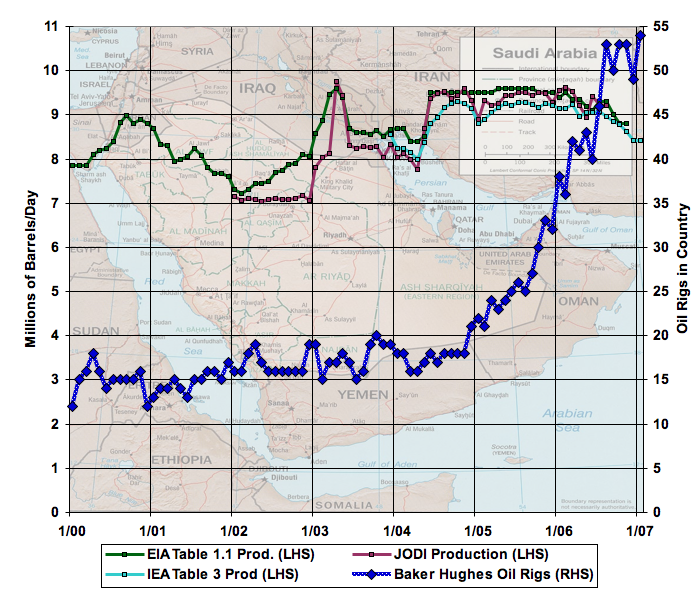
His analysis also assumes - and assumes that its backers placed a lot of money on the idea - that Iraq has massive, massive, massive oil reserves that nobody anywhere actually knows are there, and just as importantly, accepts the old Iraqi stated "proven reserves" number as real. This is a huge gamble. His noise about how Iraq has "a mere two thousand wells" drilled compared to Texas's "million" indicates a fundamental failure to understand oil extraction and technologies. Texas has hundreds of thousands of rigs because they're generally tiny, actively pumping out one or two barrels a day (literally) of oil from mostly-dead fields. They have huge water cuts and are incapable of large-scale production. By contrast, Saudi Arabia's world-leading oil production over the last couple of decades has come from literally as few as 20 very high production oil rigs. (Note here for a graph.)
(I do want to note that I oversimplify, rigs != wells, etc. But the point remains.)
So, by some standards, the above counts as a "happy path out of this," which is to say, no path out of it at all, and a second round of American colonialism. It will certainly be happy for some if it works out. I have my doubts about that, but once that path has been sufficiently traveled, there'll be no turning back, and I think it will unfold unhappily. A 50-year stay is the explicit purpose of the Bush administration - that's what he means when he goes on about the "Korea model." Only in this case, it's not a block against a larger power; it's resource appropriation.
As to what to "watch for," well, I'm not sure what you mean. It's kind of all happening in front of you if you want to see it. Oh; this does imply that near-term peak-oil theory is not only accurate (as I think the numbers are starting to bear out, but I am not - specifically not - calling peak oil now, just near-term) but taken more seriously by upper-level oil and policy people than anyone will admit. So track oil production numbers. If I'm right, and I think I am, then the more they fall, the less the Democratic party will do to get American forces out of Iraq, even with the sizable majorities their supporters demand are necessary to actually, you know, do things. If we get another significant production - and export, that's separate and important! - bump, then that'll be a window of opportunity. But it will be temporary.
A better model - at least, if you consider colonialism and empires as antithetical to liberty as I do - would be entirely different.
60% of American oil consumption is in personal transportation. That's not an accident. On all levels, a massive automobile-based transportation system was a governmental goal from the 1920s forward. It was the overarchingly dominant model following World War II, and it is still the goal for most of the USA, including the Federal government in particular, which, under the current administration, has gone so far as to try to order states to junk other approaches. (C.f. a post I made several months ago about the Feds telling Oregon that 'people have voted with their cars' and 'demand' a roads-only approach, so throw out all this transit crap and get building more highways.) Everything from Federal policy at the top to local zoning is about enabling automobile transit and discouraging everything else, outside of a few exception regions. (Cascadia, parts of the New England corridor... and that's about it.)
The United States is the third largest producer of oil in the world. With a different transportation focus and an efficiency drive in industry - one already ongoing even at $80/barrel - the US could be an oil exporter. Think about that: the US could be eligible to join OPEC. That is how much is energy is thrown away by this transportation model. And that six (or nine, depending upon how you count it) decades of emphasis on actively promoting and enforcing car-only transportation is also why the US is becoming a colonial power again.
So. The way out would be to stop the government's autos-uber-alles approach and build a better transportation network. I've talked about my experiences on Japan's rail system; it's superb. More importantly, it's more convenient than driving around here, and driving around the other places I've driven around. It takes less personal time, if you build it right, than the strip-mall-and-highway model the US has now. Both this and industry movement away from oil use could be prompted by a steady and substantial over time increase in the gasoline tax, and a similar set of staging on industrial oil sales. Do that, and the markets will take care of most of it, as they should. This solves all kinds of problems - reducing international tensions, improving US security, reducing the trade and budget deficits, cutting pollution, and so on.
But this doesn't build empires, and it doesn't help consolidate governmental power in the executive the way both empires and war do. And it doesn't help grow the oil industry, and it's not real good for GM1. Decades of propaganda isn't easy to overcome, so almost certainly won't be; and as has been noted many times as of late, Presidential approval ratings and gasoline prices are almost perfect inversions of each other. So this will not happen - at least not on a national scale.
I hope - and work - for better, here. I fight the mass appropriation of Federal and Presidential power, to curb the abuses, to keep options open, and basically just to try to keep them off our backs. I support regional approaches and solutions to all of these problems. (Call it Cascadian nation-building if you want, but when national solutions won't happen, regional ones must.) I'd like to see our taxes - incidentally, we're a tax exporter, one of the bigger ones by percentage - stop going to fund these pointlessly destructive policies. I work for local renewable energy adoption and production, such as collecting signatures for the recent renewables initiative. I'll be voting - with nose clamped tightly shut - for the Sound Transit rail expansion, because as bad as it is, it's better than failure. Obviously, I hope other people will do the same sorts of things. And specifically work for regional solutions, because the Feds won't be helping.
So my realistic "happy path out of all this" - really, the least unhappy realistic path - is to minimise the damage on the Federal and international levels, and a set of regional solutions that solve the problem here, so that if things indeed go badly south for the imperial solution - as I think they will - we don't fall over. But really, all that depends upon controlling the Federal behemoth. If damage can be reversed at the Federal level, so much the better. But when push comes to shove, I will not be part of a torture state. And that's all I have to say about that subtopic.
1: (Note: I would not, for a second, consider banning cars. Or taking apart the highway system. Every family should have a car. They're great for cargo and emergencies, just for example. It's fundamental car - and hence oil - dependence that's central to this problem. And no, fission+electrics aren't going to solve that any time soon. I've done that math. There's not enough uranium in the world.)
technoshaman, and the second in three parts to llachglin. I'm collecting the technoshaman replies here, as - edited back together - they form a postlike entity; the replies to llachglin really don't, as they're separate to each section.Oh, and in that reply - reproduced here - I link to this article in the London Review of Books, found courtesy Andrew Sullivan. You may find it cogent.
technoshaman asked: So what do you see as the happy path out of all this, and what do we have to watch out for?I reply:
Do you want what will happen or what could - or, arguably, should - happen but won't?
What will happen, most probably, is outlined very well today here, in the London Review of Books, of all places. He even makes the tie back to the Cheney Energy Task Force, an idea I'd been toying with recently as well. I was telling people circa 2003 that this was fundamentally about oil; that became intensely clear after Sec. Rumsfeld said so in Korea when he didn't think any American reporters were listening. (And the stated rationales were always insane to anyone who had more than six months' worth of memory. Sadly, that apparently includes very few Americans, and almost none of the political class.)
But that ignores a variety of other ramifications. With this, the USA becomes a colonial power again. An important question will be whether the second American colonial era comes closer to the British model or the Dutch. Sadly, we need to hope for the British, despite its long series of tragic farces; the Dutch, on the other hand, were much more directly into extermination campaigns throughout. Colonial powers are always repressive abroad and are generally fairly repressive - though usually less so - at home. (Particularly towards those opposed to the Empire.) Mr. Holt's analysis also underestimates the inevitable Chinese reaction, which will be to draw a western line in the sand to American adventurism, quite possibly in Iran, thus getting the Neoconservative movement their 1990s goal back again: a new cold war with China. Overall, I see the LRB case as overly rosy, tho' still basically accurate. And, of course, as with most colonial adventures, the companies running it will profit the most.
(Politically, fwiw, the US seems to be trying to follow the British model, but the backers of the current administration are not at all unlikely to end up with the Dutch model over time, following their social structures to a reasonable conclusion, and taking into account American colonial history in the Philippines.)
His analysis also assumes - and assumes that its backers placed a lot of money on the idea - that Iraq has massive, massive, massive oil reserves that nobody anywhere actually knows are there, and just as importantly, accepts the old Iraqi stated "proven reserves" number as real. This is a huge gamble. His noise about how Iraq has "a mere two thousand wells" drilled compared to Texas's "million" indicates a fundamental failure to understand oil extraction and technologies. Texas has hundreds of thousands of rigs because they're generally tiny, actively pumping out one or two barrels a day (literally) of oil from mostly-dead fields. They have huge water cuts and are incapable of large-scale production. By contrast, Saudi Arabia's world-leading oil production over the last couple of decades has come from literally as few as 20 very high production oil rigs. (Note here for a graph.)
(I do want to note that I oversimplify, rigs != wells, etc. But the point remains.)
So, by some standards, the above counts as a "happy path out of this," which is to say, no path out of it at all, and a second round of American colonialism. It will certainly be happy for some if it works out. I have my doubts about that, but once that path has been sufficiently traveled, there'll be no turning back, and I think it will unfold unhappily. A 50-year stay is the explicit purpose of the Bush administration - that's what he means when he goes on about the "Korea model." Only in this case, it's not a block against a larger power; it's resource appropriation.
As to what to "watch for," well, I'm not sure what you mean. It's kind of all happening in front of you if you want to see it. Oh; this does imply that near-term peak-oil theory is not only accurate (as I think the numbers are starting to bear out, but I am not - specifically not - calling peak oil now, just near-term) but taken more seriously by upper-level oil and policy people than anyone will admit. So track oil production numbers. If I'm right, and I think I am, then the more they fall, the less the Democratic party will do to get American forces out of Iraq, even with the sizable majorities their supporters demand are necessary to actually, you know, do things. If we get another significant production - and export, that's separate and important! - bump, then that'll be a window of opportunity. But it will be temporary.
A better model - at least, if you consider colonialism and empires as antithetical to liberty as I do - would be entirely different.
60% of American oil consumption is in personal transportation. That's not an accident. On all levels, a massive automobile-based transportation system was a governmental goal from the 1920s forward. It was the overarchingly dominant model following World War II, and it is still the goal for most of the USA, including the Federal government in particular, which, under the current administration, has gone so far as to try to order states to junk other approaches. (C.f. a post I made several months ago about the Feds telling Oregon that 'people have voted with their cars' and 'demand' a roads-only approach, so throw out all this transit crap and get building more highways.) Everything from Federal policy at the top to local zoning is about enabling automobile transit and discouraging everything else, outside of a few exception regions. (Cascadia, parts of the New England corridor... and that's about it.)
The United States is the third largest producer of oil in the world. With a different transportation focus and an efficiency drive in industry - one already ongoing even at $80/barrel - the US could be an oil exporter. Think about that: the US could be eligible to join OPEC. That is how much is energy is thrown away by this transportation model. And that six (or nine, depending upon how you count it) decades of emphasis on actively promoting and enforcing car-only transportation is also why the US is becoming a colonial power again.
So. The way out would be to stop the government's autos-uber-alles approach and build a better transportation network. I've talked about my experiences on Japan's rail system; it's superb. More importantly, it's more convenient than driving around here, and driving around the other places I've driven around. It takes less personal time, if you build it right, than the strip-mall-and-highway model the US has now. Both this and industry movement away from oil use could be prompted by a steady and substantial over time increase in the gasoline tax, and a similar set of staging on industrial oil sales. Do that, and the markets will take care of most of it, as they should. This solves all kinds of problems - reducing international tensions, improving US security, reducing the trade and budget deficits, cutting pollution, and so on.
But this doesn't build empires, and it doesn't help consolidate governmental power in the executive the way both empires and war do. And it doesn't help grow the oil industry, and it's not real good for GM1. Decades of propaganda isn't easy to overcome, so almost certainly won't be; and as has been noted many times as of late, Presidential approval ratings and gasoline prices are almost perfect inversions of each other. So this will not happen - at least not on a national scale.
I hope - and work - for better, here. I fight the mass appropriation of Federal and Presidential power, to curb the abuses, to keep options open, and basically just to try to keep them off our backs. I support regional approaches and solutions to all of these problems. (Call it Cascadian nation-building if you want, but when national solutions won't happen, regional ones must.) I'd like to see our taxes - incidentally, we're a tax exporter, one of the bigger ones by percentage - stop going to fund these pointlessly destructive policies. I work for local renewable energy adoption and production, such as collecting signatures for the recent renewables initiative. I'll be voting - with nose clamped tightly shut - for the Sound Transit rail expansion, because as bad as it is, it's better than failure. Obviously, I hope other people will do the same sorts of things. And specifically work for regional solutions, because the Feds won't be helping.
So my realistic "happy path out of all this" - really, the least unhappy realistic path - is to minimise the damage on the Federal and international levels, and a set of regional solutions that solve the problem here, so that if things indeed go badly south for the imperial solution - as I think they will - we don't fall over. But really, all that depends upon controlling the Federal behemoth. If damage can be reversed at the Federal level, so much the better. But when push comes to shove, I will not be part of a torture state. And that's all I have to say about that subtopic.
1: (Note: I would not, for a second, consider banning cars. Or taking apart the highway system. Every family should have a car. They're great for cargo and emergencies, just for example. It's fundamental car - and hence oil - dependence that's central to this problem. And no, fission+electrics aren't going to solve that any time soon. I've done that math. There's not enough uranium in the world.)


![[identity profile]](https://www.dreamwidth.org/img/silk/identity/openid.png)
no subject
Date: 2007-10-11 09:02 pm (UTC)Problem is, even if we manage to totally Balkanize Cascadia, we still have to put up with the foreign policy. And there's the little problem of the empire is not gonna have leigions very much longer if they keep feeding them to the meat grinder and no replacements are stepping up.
This juggernaut needs a sabot, a wooden shoe for its works...
Meanwhile back at the ranch, I would not underestimate the power of simply saying the truth until you're blue in the face. Ask Vaclav Havel. Or Lech Walesa. It may take longer than we'd both like, but it's got a reputation of working eventually.
no subject
Date: 2007-10-11 11:52 pm (UTC)I certainly don't want to do that. I think we have a lot in common as a region and I certainly don't want to break it down into a million warring fiefdoms. Indeed, avoiding that sort of thing is very important to me.
That said, given what I think you probably mean, I suspect I would refer to it as more of a substantial re-Federalisation.
we still have to put up with the foreign policy.
Indeed, and note that my comments on ignoring the Fed didn't include its foreign policy decisions. It's more of a domestic set of decisions.
This juggernaut needs a sabot, a wooden shoe for its works...
Hm. Having looked up "sabot," I am confused by your analogy. But, well.
no subject
Date: 2007-10-12 12:14 am (UTC)We fought that war once, about 150 years ago... got our butts handed to us.
If you've got a better way to get us shed of the Emperor and in one piece, I'd love to hear it. If we could get ourselves UN-recognized we could cause all kinds of trouble for His Occupancy... big fun!
"sabot," I am confused by your analogy.
It's a somewhat suspect etymology (http://en.wikipedia.org/wiki/Sabotage#Origin), but I rather like it.
no subject
Date: 2007-10-12 12:35 am (UTC)